
this is not about clouds

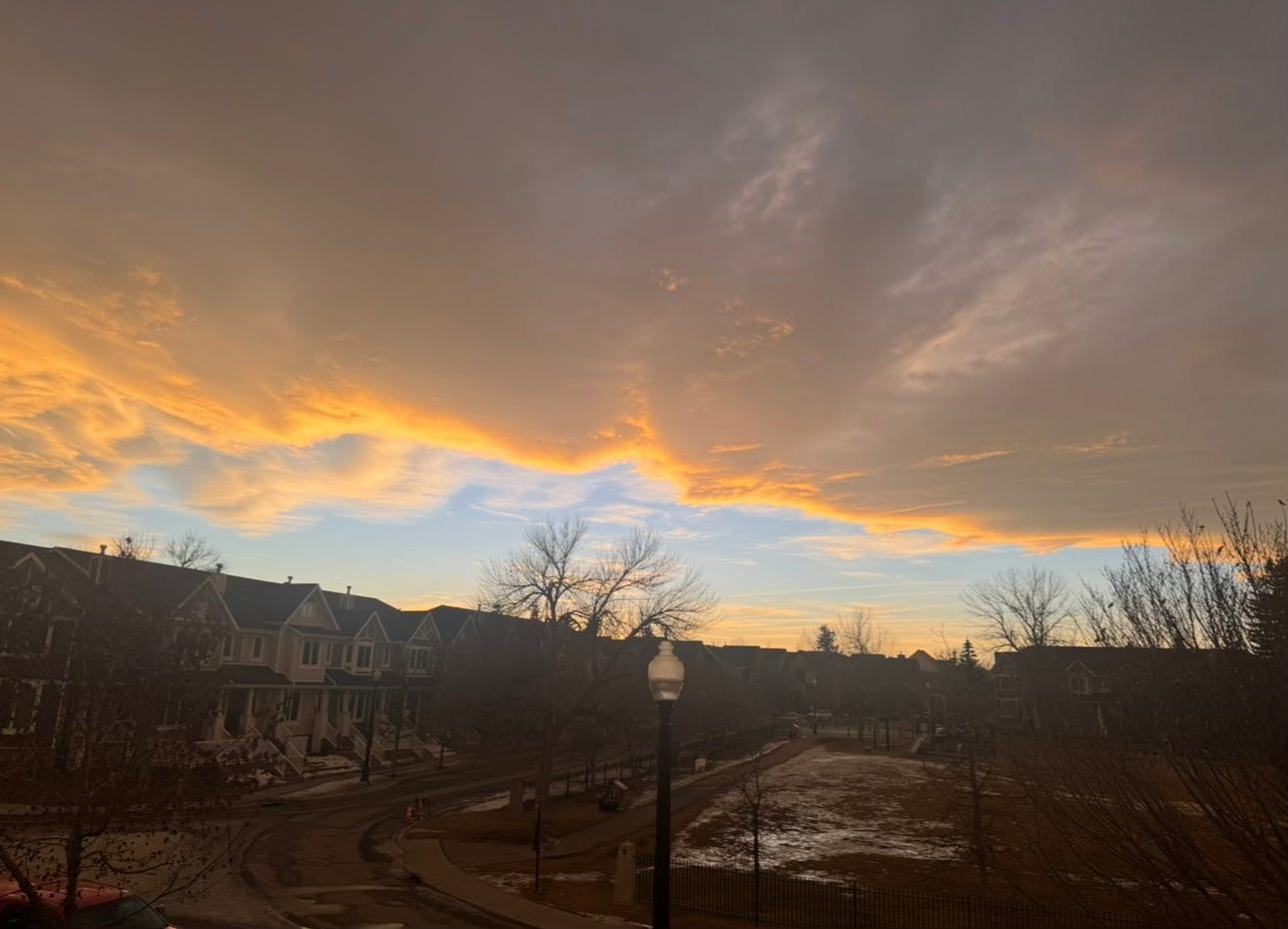
[photograph taken yesterday at 5:32 pm]
I was going to write about clouds. I was going to tell you about a different photograph (than the one above), one of me floating on my back in the water looking at the clouds. That day on the lake my arms stretched out to form a T, legs together, left foot over right. There was a duck nearby, and another swimmer in the distance. The clouds were cumulus, round masses heaped on one another, and I felt weightless, which is what water does to the body.
I was going to write about how clouds are often dismissed because they are common, presumed unremarkable by their frequency alone. Whether or not something is remarkable has nothing to do with how often it appears. Clouds regulate temperature, reflecting sunlight back into space and trapping heat at night, moving water across the earth. Meteorologists read clouds the way psychics read tea leaves, to predict what is coming.
Olivia and I finished the third instalment of an adaptation of Charlotte’s Web on television. I knew Charlotte dies, but it had been a while since I’d read the book, and I had forgotten the circumstances of her death, forgotten that she was too weak to return to the farm, forgotten the line, “No one was with her when she died.” I cried then, and cried again now.
“That is so sad,” Olivia said, adding that it was sadder still that Charlotte died alone.
During the pandemic, people died alone. In less remarkable times people die alone too (I thought). When I first called the volunteer coordinator at the old folks’ home, I asked whether people died alone there. The conversation shifted to hospice and palliative care training, to the end-of-life accompaniment volunteer work I do with them now. And while I haven’t been doing this work long, I am no longer convinced that people die alone (really).
I recently read Death-Bed Visions, by Sir William Barrett, published in 1926. Barrett collected accounts of dying patients reporting vivid visions shortly before death (typically a week or two before), often accompanied by a visible calm. Barrett resisted explanation. He wrote of a dying child who, afraid of going alone, suddenly seemed reassured after he saw something no one else in the room had seen, he cried out, “I am not afraid, they are all here.”
I never ask who they are. I watch the patient’s eyes move slowly, deliberately, as if following someone crossing the room, the furrow of their brows softens as their eyes fix on something I cannot see. I try to see it. I track the patient’s gaze to the place on the wall they are looking at, and back to the patient.
In the training, we were encouraged to step into the patient’s reality. They may see loved ones that have already crossed over, or God, or a warm, bright light. I wait to be invited into this reality. But most of the time the invitation doesn’t come. These moments aren’t mine, my job isn’t to follow, but to stay, to keep the room as it is, to sit with their body until their mind returns from somewhere I cannot yet reach.
This is universally relevant to every human, Kate. And comforting.
Beautiful Kate